Left Puerto Villemil around 11am. We got in about 8 hours of slow sailing till the winds shutdown in the evening. Ended up motoring all night. Filled our tanks running the watermaker while the engine was running. A little after sunrise the winds filled in enough to start sailing -- slowly. But it is nicer than listening to the engine rumble. We are on a starboard tack, moving SE.
All's well - OK almost all is well. My back hurts and Chris' toe is looking a little ugly.
Paul
----------
radio email processed by SailMail
for information see: http://www.sailmail.com
Showing posts with label Galapagos Ecudaor. Show all posts
Showing posts with label Galapagos Ecudaor. Show all posts
Wednesday, March 4, 2015


Monday, March 2, 2015
Loading Up at the Organic Farm
 Part of Chris’ haul- fresh chiles, or pimientos as they’re called here.
 Fenced to keep the free-range tortoises out?
Pineapple hunting.

Green tomato hunting – they ought to last awhile.

Chris and Dwyer paying up.

OK, a few more animal photos before we leave. This young sea lion is fully enjoying our anti-seal defenses on the swim step. They’re so much like dogs you want to pet the little ones.

“Excuse me lady, exactly why did you kick me off the step?”

And finally, one of the scary looking vegetarian marine Iguana swimming on by the boat- they just swish their tail back and forth.
Tomorrow we’re off for Easter Island.
Paul
Galapagos – We Don’t Want Your Kind Here

Stashed his trash in Ecuador, bought new suit of clothes…
This is the voyage of the Beagle when Charles Darwin was aboard as they passed through the Galapagos (September, 1835). We’ve now been in the Galapagos almost as long as Darwin was and I’m feeling like I should come up with an earth shattering theory or two. I haven’t, but it actually took Darwin another 25 years after his visit before he published his theory of evolution. So I guess I have some time.J. Buffet
 With all the restrictions and costs put on private cruising boats coming through the Galapagos, it is pretty clear they don’t really want us here. The real way to see the Galapagos would be on small ship like m/v Grace above. It is beautiful classic that was the honeymoon ship for Grace Kelly of Monaco. It takes 18 just passengers and it would cost you about $5,800 for an 8-day passage – but I bet you wouldn’t forget it.
 Yesterday a German flagged boat came through here. They did not get an Autografo (entry papers for Ecuador) before they arrived, so they were at the mercy of the Port Captain. I told them they needed to contact an agent before doing anything else but they decided to go ashore. Meanwhile the quarantine health officer and someone from the Port Captain’s office came out to the boat. They were not onboard and the next morning they left for the Marquesas having been denied entry here. It seems they were booted out because they had the Galapagos on their Zarpe (check out papers from the last country which states where you’re headed next) but had not applied for the Autografo. It may have been their own fault for nor following the basic rules. But the rules here are not always clear and even if you follow the rules, there are so many restrictions put on a cruising boat that you don’t run into in other places. It’s a tricky one.
 A local resident, a Sally-light Foot crab
We are getting now ready to make our next hop, westward across the Pacific. This time to Easter Island, also known as Rapa Nui. It is about 2,000 miles South and West of here. Although Easter is part of Chile now, it is historically a Polynesian island. The island lies about 2,000 off the Chilean coast. It is a pretty remote place that offers cruising boats like ours only a few difficult open-roadstead anchorages. Our plan is to leave on Tuesday morning - sail as much South as possible, trying not to go West, at least for the first 600 miles or so. Then we’ll check the weather faxes and decide when to turn right and point straight at Easter. Right now there is a wind hole below Galapagos that doesn’t show any signs of leaving. This means we will probably have to motor on and off through the first 180 miles or so – we’ll see. We are expecting about 16-17 day trip, or so.
We were following the blog of a sail boat that left the Galapagos a day before we came to Isabela on their way to Easter Island, Sundancer. They had a very slow first 6 days. I just checked their position and it turns out that after 8 days or so, they decided to turn around and sail back north to Mexico. Apparently they are going to Mexico to do some repairs.
I got another article published in Blue Water Sailing March 2015 issue:
The Cruiser’s Scavenger Hunt How to successfully navigate the clearing in and out process as you cruise, and the valuable cultural experiences that make it worth the effort
Paul
Friday, February 27, 2015
Vermillion Flycatcher Spotting

I know it is bad blogger form to start out with a spoiler alert and give away the finale, but here’s the Vermillion Flycatcher that are trusty guide spotted on the way back from hiking Volcano Sierra Negro. Chris asked the guide if we might see any along the trail. He told us that we had to descend to about 700-800 meters and stick close to him. He sent the rest of the tour group on down the trail and took Chris and I off the beaten path over to a fence along a guava orchard. After 100 yards or so, he spotted this beauty hanging out on a close by branch. For those that are not that wordy, vermillion is a shade of red, kind of like taupe.
 Our national park guide Julio reviewing our basic geology lessons on volcanoes. However, his main job was to make sure he came out of the mountain with the same number of folks he went in with.
 In the spirit of doing the blog out of order. This is the taxi that picked us up near the dinghy dock. We thought it was taking us into town so we would board the mini-bus heading to the mountain. But he took off for the Volcano, with Chris in the front, two ladies from Guayaquil in the back seat and me and a local sitting in the pickup bed. I spent most of the bouncy 40 minute trip up the mountain looking for my seatbelt.
 The volcano's caldera is the second largest caldera in the world. I’ll leave it to someone with much better Internet bandwidth than we have to ask Google what is the largest one. You can’t see it well in this picture, but the upper 1/3 of the Caldera in the background is covered in green growth. The nearer part is rugged lava flow. The whole caldera was green till the 2005 eruption.
  The eruption put ash 25,000 ft in the air. It must have been a more interesting hike back then. (Picture from panarimio.com)
  After we made the peak of the caldera rim, we started hiking down the north side of the volcano. This Sierra Negro tortoise was lounging on the side of trail where the grasses were still growing -
 Plus a few flowers.
This is Chris checking the view of the badlands on the north side where much of the last eruptions have flowed. It is also the drier side of the mountain.
 This was the scene at the dinghy dock when we back mid-afternoon. It was apparently a tough morning fish hunt for the sea lions, siesta time.
Paul
Monday, February 23, 2015
The Tunnels – Isla Isabela, Galapagos

We signed up for a boat tour of the ‘Tunnels’ ($80 per person, 5 hours). On the way down to the south end of the island we were about 2 1/2 miles offshore in dead calm when the driver stopped the boat so we could check something frolicking in the water. It was 3 or 4 Manta Rays. These beasts get up to 22 feet wing span. The one in this picture is traveling under the boat, hence my shoe in the image, and is probably about 15-18 feet wing span.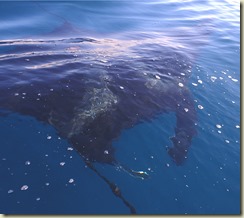

 The top side is mostly black and the underside here in this picture is white. They are magnificent creatures who amazingly eat plankton by filter feeding – up to 60 lbs a day. Just seeing these guys offshore made the tour worth it.
To get into the Tunnels they drive the tour boat at high speed through the breaking surf line. That’s Dwyer from s/v Rascal filming with his GoPro. He’s a single-hander who made it here, Isabela island, from Huatulco, Mexico – about a 1,000 mile passage. He’s heading to Chile via Easter Island in a few weeks. His goal is to go do some remote back country skiing off his boat from the Chilean canals.
 The tunnels are made up of volcanic lava with dozens of arches, above and under the water. These are the remnants of lava tubes formed during volcanic eruptions. Isla Isabela is made up of 5 semi-active volcanoes and the landscape is all volcanic rock.
The barren land makes for good boobie hangouts.

The penguins at this end of the island are apparently a long way from any dry-cleaners – they were all having bad hair days.
 If you look just about dead center of this pic you can see a large green turtle cruising through the lava maze.
 Cactus on the shore and turtle in the water.
Lot of underwater volcanic caves for the fishies to hide in.

A school of razor fish cruising by.

A ray hiding in the shade of a tunnel.

This one is hard to make out, but it is a seahorse,about 4-6 inches tall, sitting in a crack in the lava about 12 feet under.

A big green turtle moving close by underwater. These guys weren’t the least bit skittish, unlike so many of the turtles we’ve seen in other places. They’re accustomed to the tourists and seem to understand that they’re part of the show here.

That’s Chris getting up close to the same turtle.

This place is famous for the white-tipped sharks who come to the shallows to rest in the underwater caves.

Can you guess why they call them white-tipped?

One of the offshore islands we went by on our way out, with boobies on top.
Paul
Sunday, February 22, 2015
The Wall of Tears

We rented bikes in town (at $2 per hour) to ride out the 7km dirt trail to El Muro de las Lagrimas – The Wall of Tears. The wall was built by convicts that were kept on the island – before tourism was such a hit – from 1946 to 1959. The wall is completely purposeless, except to make the life of the convicts even worse. It is an impressive dry-stack, but you really would have thought that the prison commandante could have come up with a project that at least furthered his needs. The wall goes from one side of a small valley to the other and does nothing. I’m sure somewhere near here you could find a fairly large unmarked grave of the inmates who never made it out.
 Free range tortoises were along the road where there was shade under growth.
The park has put in helpful interpretive signs like this one – No tortoise petting.

And for those of us with long hair, there was some demonstration signs of how to take the down hills.

Its kind of hard to see, but the background peninsula is covered with blue-footed boobies. The bike trail runs along the ocean for most of the way till it heads up hill to get to the prison site. Which, for me, conveniently made it downhill on the way back.

Nearer town on the trail was a locals cemetery. It seemed like they were all new comers, I didn’t see any old markers.

That evening from the back of the boat we were entertained by hundreds of bombarding blue-footed boobies going after their evening meal.

Not great focus, but here are the boobies just as they hit the water. The little fry didn’t have a chance.

This afternoon we did a snorkel at one of the only places we are allowed to go without a National Park guide. Here is an artist rendition of a penguin shooting by us underwater. These guys are bullet fast underwater, and hard to see much less photograph.

Chris found this 10-12 inch open oyster. If you biggerrate by clicking on it you can see a striped 3-1/2 to 4 in fish on the lower lip.

And a gratuitous mangrove photo for our friend Save-the-Mangroves Will. You can see a heron center top hanging off the mangrove waiting for a fish to come by.
Paul
Thursday, February 19, 2015
A little Isabela Wildlife
 These Galapagos penguins are hanging on the rocks just near where we are anchored. We call it Drycleaner Point. These little guys are similar to the tuxedo dressed penguins of the Antarctic, just without the extra layer of body fat insulation since they live at the Equator.
There’s some good trails around Puerto Villamil for checking out the wildlife. Here’s a curlew, or maybe an Ibis. Our tropical Pacific bird book doesn’t cover the Galapagos so we have to make up most of the identifications.

Definitely a Galapagos duck.

This is the other end of the same duck, perhaps making identification easier, while she’s working for her dinner.

Lots of Flamingos in the mangrove swamps. Check the ugly duckling sitting on the log.

This queen was getting all fluffed up.

They’re not all colorful, but they make a good noise.

Can’t forget the blue-footed boobies. They dive bomb for their fish breakfast every morning by the hundreds, just off the rocks by the boat .

Another pond side feeder, a variety stilt.

Can you guess how to tell that this is a marine iguana instead of a land iguana?

Marine iguana digesting his seaweed in with the help of some warm sun. When they’re not swimming, they’re pretty lethargic.

 Except for their shell, they really have no other protection mechanism from predators or man. Sailing ships stopped here over the centuries to stock up on the giant turtles, as they lived a long time in the holds of the ships without food or water – and gave up nice fresh meat.
The sea lions on Isabela are not nearly as pushy as the ones on San Cristobol. This baby broke through our seal defenses and took a little nap on the swim step.
Paul
Subscribe to:
Posts (Atom)

 Posts
Posts


