A Merry New Year to our blog reader from the top of Table Mountain, 3,563 feet (1,086m) above Cape Town. We took the cable car up on a summer day in December. Along with boat projects we've been getting in some touring of Cape Town and the surrounds. Its an interesting area with lots of varied topography and interesting history. It is very tourist friendly, at least on the surface. Pretty much every local you talk with has a heap of safety warnings for you and they all have horror stories of robberies and worse. The area immediately around the marina is pretty safe for walking around and going out for dinner at night. We are a bit on the cautious side, but still get around, taking an Uber more than we would normally do to avoid walking in areas we don't know.
Last week two boats on the dock in the marina we are in got boarded -- even though, we still consider this marina to be safe. It did inspire us to turn on the boat alarm at night while we are sleeping.
Speaking of walking around Cape Town. Here is the Parliament building as we walked through the The Company Gardens on our tour.
And here is the Parliament building yesterday during a devastating fire.
__________________________________________________________
To get back to some touring pictures. This is Table Mountain with its famous table cloth on.
The unique ecosystem around the Western Cape is called the Fynbos.
If you are into flowers and reeds, the Fynbos has a fascinating collection, many unique only to this area.
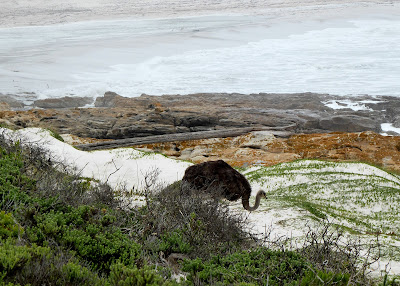
It has a few interesting animals too. This ostrich was grazing next to the trail on our Fynbos hike along the beach.
Here's his buddy right on the beach
A massive whale vertebra washed up on the beach.
Even better than flowers and animals was this rusty stuff. This is the wreck of the Thomas T. Tucker, a World War II Liberty Ship. The liberty ships were rapidly constructed, cargo ships designed to haul supplies from the US to the allies in Europe prior to the US entering the war. The Tucker was launched August 31,1942 in New Orleans. She was on her maiden voyage from New Orleans, around the southern tip of Africa to supply allied troops in Suez. Due to the risk of German U-boats the Tucker navigated close into shore in thick fog on November 27,1942. The captain made a navigation mistake and assumed they were close to Robben Island (the island latter made famous as the prison that Nelson Mandela spent 18 years on). The crew relaxed and the ship was lost on Olifantsbos Point, near Cape Point. The Tucker joined hundreds of other ships that came to similar ends along this coast, also known as the Cape of Storms, since the 1500's.
A black, leopard gecko cruising on the Fynbos granite.
Pretty rugged coast of the Cape
This antelope type herd of Bonteboke in the distance are also enjoying the beach, just a 100 yards west of the surfers.
---------------------------------------------------------------------------------------
Back to downtown Cape Town touring, we stopped at the 150 year old flower market.
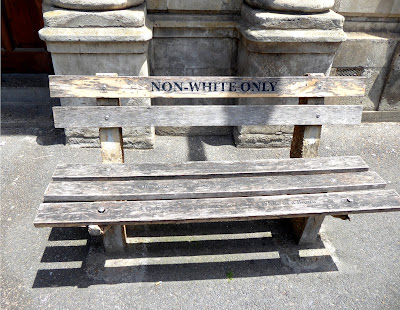
Here we are in front of the Race Classification Board building (1959 to 1991). The two benches sit on either side of the entry. One for Whites and one for Non-whites. From 1950 to 1991 the Population Registration Act classified all South Africans as one of seven races (with three primary categories, white, coloured, black). Based on your race you had a sliding scale of citizenship rights with "White" having full rights and "Bantu" have the least rights. The classifications were very subjective, with many cases of families being spilt apart with different race classifications applied to different members, based on skin color, curliness of the hair, color of the nail cuticle, generally accepted member of aboriginal tribe.
According to the law, a person was white if they were “obviously...[or] generally accepted as White." The definition of 'native' was even more revealing: "a person who in fact is or is generally accepted as a member of any aboriginal race or tribe of Africa." People who could prove that they were 'accepted' as another race, could actually petition to change their racial classification. One day you could be 'native' and the next 'colored'. This was not about 'fact' but perception. https://www.thoughtco.com/racial-classification-under-apartheid-43430
Seeing these signs reminded me of when I was a little kid and my parents moved to Florida. In 1959 Florida was truly part of the Deep South. I remember being on a bus with my Mom and seeing the sign for the Colored seats in the back and going to the local the grocery store that had two drinking fountains, so blacks and whites didn't have to share the same water supply. If I had to judge the success of each country getting out of there past, I can't say I'd give either country a grade higher than a C.
-------------------------------------------------------------------------------------------------
The view the V&A waterfront from the top of our mast. It is a bit Disneyland like, but fun and well used by international and local tourists as well as Cape Towners.
Dock neighbor
This is a long row of brand new, Leopard Catamarans built by the Robertson and Caine factory here in Cape Town. They pop out somewhere between 4 and 6 cats a week. These are all pre-sold and mostly waiting to go on ships to the Caribbean and USA. If you have a spare usd$600 to 800,000 lying around, you could get in line for one. They used to be delivered on their own bottom's, ie sailed over. An unfortunate, ill-timed delivery that ended in the loss of crew put an end to that.
Another dock neighbor sitting next to Georgia.

This is where the Cape Fur Seals are supposed to hangout. Unfortunately this is mating season and they are close enough to us so that we hear the males barking and fighting with each other all night. And considering how often they bathe, they sure sink.
A 4 foot size Sunfish (Mola Mola) who also likes to hang out around the docks.
We have excellent grocery stores near by which makes life a lot more pleasant. Especially if it is late in the day and you suddenly realize you are completely out of ostrich meat.

And one more critter found in the Fynbos, some free-range Flamingos.
Paul






 Posts
Posts


