Sunday, February 24, 2019

Australian Wooden Boat Festival

wooden-boat-festival3
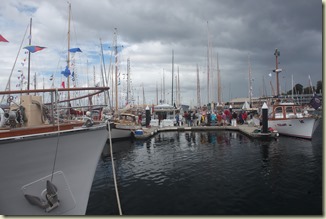
The Australian Wooden Boat Festival is held in Hobart, Tasmania every other year. It is much like the Port Townsend Wooden Boat Festival held back in the Puget Sound fall. A number of the rock stars from Port Townsend (Washington) come down and present at the Tasmanian show – Carol Hasse, Brian Toss, Lyn Pardey. The organizers do a great job of turning the downtown docks into an open air festival. Admission is free and so are all the presentations for the four day shindig.
TasIMG_9635
The weather for the show was pretty decent considering it is in Tasmania. A little warm. a little cold, a little sunny and a little rainy.
TasIMG_20190208_131145
The tallships making their way up the Derwent River to the show was impressive.
TasIMG_20190208_134422
The larger ones had a nice tug assist to the dock at the historic port.
TasIMG_9636TasIMG_9640
Some of the tallships were not content to stay at the dock and went out with festival goers a couple of times day.
TasIMG_20190208_143821
It wasn’t all old wooden boats. They had some nice classic 2-cycle outboard displays.
TasIMG_9642
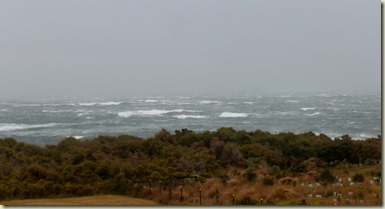
After the boat show we rented a car to do a bit of land touring. The weather decided to take a pretty hard turn toward what we might call winter. This is a picture of Bass Strait from Low Head at the top of Tasmania. This is the strait that separates Tasmania from the rest of Australia. It is an intimidating bit of water to cross in a small boat. Sitting in our rental car overlooking the water here the car was continually shaking back and forth from the wind gusts. Glad we were in the car and not the boat.
tasIMG_9649
Touring on land in bad weather inspired us to go to some of the indoor tourist stops. These pictures are from the Seahorse factory. It is a breeding site for much of the world’s aquarium seahorse stock. This is what a prenatal ward for men looks like when designed by women, as the male seahorse does the incubation and labor.
tasIMG_9657Tasmania is also home to a relative of the seahorse, the Sea dragon.
TasIMG_9675
While we were stopped at the Seahorse Factory we decided to stop in next door at the Platypus and Echidna display.  This is one of the echidnas getting a snack with her long tongue and porcupine like quills.  There big claim to fame is that they are egg laying mammals like the platypus.
240px-Wild_Platypus_4
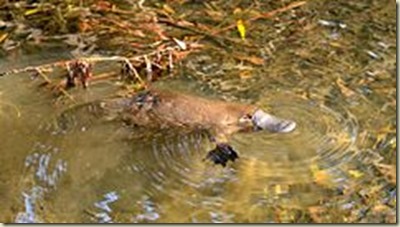
I didn’t get any decent pics of the platypus’ in their dark enclosure, so here’s one borrowed from Wikipedia. Besides being egg layers, these animals are plain weird looking.
TasIMG_9677
View of the northern coast of Tasmania, at the town of Penguin.
tasIMG_9684
Making it to the top of the sand dunes near Strahan on the wild west coast.
TasIMG_9712
TasIMG_9719
While on the west coast, we had a great 3 hour trip on the old steam train that ran from the copper mines in Queenstown to the port at Strahan.  It began operation in 1897.
TasIMG_9706
The steam engines are dual drive. One drive turns the wheels, the other is for a rack and pinion drive for the steep parts of the grade. You can see the rack running in the center of the rails here.
TasIMG_9743
The locals and the tour guides always seem to have an air of great pride in their speech when they tell you that Tasmania has 3 species of snakes and they are all poisonous. This tends to keep you more alert when hiking.
tasIMG_9738
This side of Tasmania is the wet side with a rainforest climate somewhat like New Zealand's, just a lot more harsh a weather environment.
tasIMG_9741
Deep in the forests are some pretty impressive waterfalls.

We’ve started our ascent back north from Hobart toward the mainland. This means sitting in the southeast anchorages of Tasmania waiting for a good weather window to cross the Bass Strait. Nothing seems to be showing up soon on the weather GRIBs. At least it is sunny here on Maria island while we wait.
Paul






Saturday, February 16, 2019

Tasmania

TasIMG_9491
Our trip down the lower east coast of Tasmania was nice. The best cruising we’ve done in Australia so far. Georgia is nicely tucked in corner of Wineglass Bay with surprisingly blue waters and a long sandy beach. We are at about 42* south latitude, which means that the weather (and wind) changes continually, sometimes twice or more in a day. Keeps you on your toes. 42* degrees North puts you on the Oregon – California border, or on the other side of the world somewhere in North Korea, but without the insulating landmass of North America or Northern Europe/Asia. Like most places we’ve been on this trip the locals are quick to point out that the weather’s not normally like this.
enguin
Many of the bays in Tassie are home to the little blue Fairy Penguins. (picture for Wikipedia). Chris saw a few in the water.
TasIMG_9484
We did see a number of dead Penguins along he tide line. The park ranger said they were the fledglings that leave the nest and just don’t make it on their own.

TasIMG_9536
Some days have been really warm. The island was/is in a drought that has brought on massive fires this summer. Here’s a smog set from one of our stopping places, Maria Island looking west into the smoke.
TasIMG_9524
Maria island is home to a lot of wombats. This one is resting in one of the old island prisoner’s quarters on the island.
TasIMG_9528
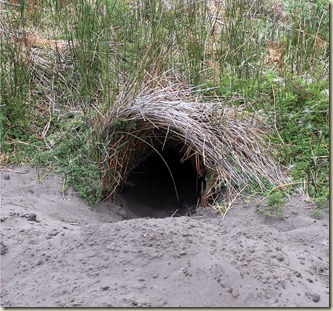
Wombats don’t normally live in prison. even the juvenile delinquent ones. They make these burrows in he sandy soil.
TasIMG_9518
I’d tell you all of the fascinating facts about the life and breeding of wombats if it wasn’t for the overwhelmingly most interesting fact. Wombats poop square!! Don’t ask me how they do this. I’ve laid awake at night trying to figure out how this could be possible.
TasIMG_9538Leaving Maria we had some hitchhikers trying to grab a ride on or anchor.
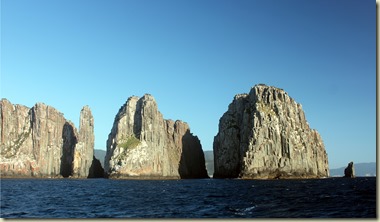
TasIMG_9554The coast along he SE section of Tasmania where it finally turns west is consists of dramatic, towering cliffs.  
TasIMG_9571
The towers and broken off sections make for a impressive view, but not one you want to mess with in bad weather.
TasIMG_20190128_153327
Once around the southeastern cape, we anchored in the very protected anchorage at Port Arthur. Port Arthur was primary entrance for prisoners transported from Britain to Tasmania, or Van Diemen’s Land as it was known then. The prison was begun in about 1830, with the main buildings completed in 1853-1855. It was a new design, shifting the punishment philosophy from physical to psychological. This meant lots of solitary confinement along with sections of the prison where prisoners (and guards) were not allowed to speak for years at a time. They only words they heard were the Sunday sermons. About 160,000 prisoners were transported to Port Arthur over its life.
Port Arthur
An 1888 view of the prison grounds.
TasIMG_9577
We started our tour of Port Arthur by getting a ticket on a guided golf cart. It was just Chris and I along with our friends Sherman and Judy, off Fair Winds. One nice thing about the tickets for Port Arthur is that they are good for two days, allowing us to do the guided tour one day and roam the next. The first place the guide took us was into the old café building. This is the site of the largest mass murder in Australia. On April 28, 1996 a gunman from the local community came into he café and slaughtered 35 tourists and workers. He was later captured and received 35 life sentences. The memorial is respectfully low key and impressive at he same time. The most remarkable result of this event is that Australia banned semi-automatic and automatic weapons and radically reduced the number of guns in it’s society. This was done with almost universal backing of the voters. Today Australia has about 1.04 gun deaths per 100,000 people, along with gun ownership of about 13.7 per 100 people. This in a country with a healthy macho wild, wild west culture. (Compared to the US, where the gun deaths per 100,000 sits at about 12 people, and gun ownership is about 120 per 100 people.)                
TasIMG_9582TasIMG_9588
The grounds are well taken care of with some restored and others just in a preservation mode.
TasIMG_9592
TasIMG_20190130_140936
The list of prison rules was long enough that it meant that pretty much everyone of them violated some term and was punished for it. Here I’m trying on the leg jewelry in advance of my next violation.
TasIMG_9612
They have some big gum trees on the grounds. To us Norte Americanos these are eucalyptus trees. The main output of the early prison was lumber to feed the English need for ship building, both commercial and naval.
TasIMG_9618TasIMG_9619
The dock inside Port Arthur is still lightly used by local fisherman. Here they are bringing large  rock lobsters. They are caught using the circular cane traps you can see stacked above he guys heads in the upper picture.

Paul


Friday, January 25, 2019

Sydney to Eden

eastBoydEdenIMG_20190119_135517
The beach at East Boyd Bay, in Two-Fold Bay, across from Eden—one of the many beautiful beaches we’ve been combing
Just a few pics from our trip along the SE coast of Australia from Sydney to Eden. We did this passage in fairly short day hops, just to avoid unnecessary overnight passages. Total it’s about 200 miles to get to Eden, the typical jumping off point to cross the Bass Strait from the Australian continent to the island of Tasmania, alos know as Van Deiman’s Land, after the Dutch explorer who first laid Euro eyes on it. On our way south, we stopped at Port Hacking, Jervis Bay, Chain Bay in Bateman’s Bay and finally Eden.
Jervis Bay is interesting because it is a large, well protected, primarily empty bay. The bay itself is part of the Australian government territory (much like Washington DC is) even though it is surrounded by the state of New South Wales. The point of this was so that the capital at inland Canberra would have control of a potential seaport thus not letting New South Wales and Sydney have a too strong bargaining position.
JervisBayIMG_20190113_144805 Judy and the snake
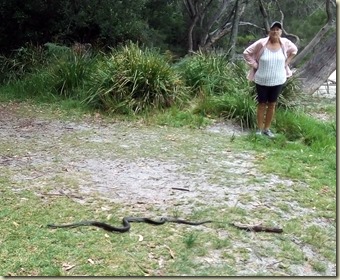
   We had to wait out weather for a day and decided to head into the park area for a walk. As soon as we got on the trail leaving the beach we encountered this snake blocking the trail. That’s our friend Judy in the back ground keeping a safe distance. They say it is some sort of a constictor. But I’m not taking any chances in this deadly country.   
JervisBayIMG_20190113_155249 Then the trail lead us to a nice beach and we were greeted by this sign— ‘'Bronze Whaler’ does not sound good. I think I’ll skip the sea bath today.
EdernIMG_20190119_153203
Eden is an interesting small town. It started as a whaling port but more recently was home to a large fishing fleet before the stocks were so depleted. There are some fish farms and afew commercial fish boats still fishing the area, but nothing like the hay day. This is a family of Roos who stopped grazing while we walked by on our hike to the old whaling station.
EdenIMG_20190118_112334
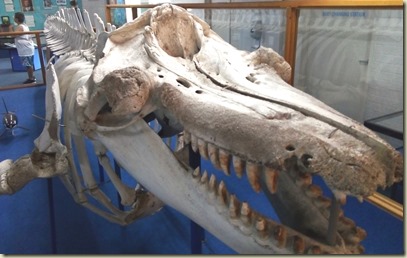
The Eden Maritime museum is one of those funky little local museums that don’t always have a consistent story between the exhibits, generally more of an eclectic grouping of old stuff-- just the way a museum should be. This is the skeleton of Old Tom. He was a killer whale (Orca) that worked for the whaling fleet in the 1920’s. His pack would herd the blubber bearing baleen whales (Southern Right Whales and Humpbacks) into Twofold Bay (the outer bay where Eden is located). Then Old Tom would swim up to the whaling fleet boats, leaping out of the water to let everyone know that the whales were in the bay. The whalers would head out on their boats and quickly dispatch the whales. They’d drag the carcasses of the unfortunate whales to shore and remove the blubber. Then they’d take the carcass and anchor it in the bay to let the orcas eat the tongue as an up to 4 ton reward for their part in the slaughter. When Old Tom came back into the bay in September 1930 to die the grateful fishermen decided to preserve his bones – which are now the highlight of the maritime museum.
The museum has other interesting stories like the tale of James Bentley, a whaler, who was swallowd by a Sperm Whale. Only later to be freed when the whale was caught and rendered. You might have heard about the story of Jonah and the Whale – similar. It was dully reported in the 1891 English newspapers and in the 1928 Australian papers. Turns out it was an early incarnation of Fakenews.
EdenIMG_20190119_145807 I did get to see some rusty stuff. This is the Try-works at the Davidson Whaling Station. It’s on the bay opposite Eden and was in use till 1929. The Try-works is where the cooked down they blubber.
EdenIMG_20190117_182649
In walking around Eden we did run into the high-tech incubator section of town. I believe this is an Aussie networking startup company: Netmakers.
Paul