Friday, September 15, 2017

Fulanga, Lau Group

FulangaIMG_4003
We reluctantly left Yagasa to sail into the 20kt winds toward Fulanga. The trip was just long enough to remind us how much we don’t like sailing close hauled into the wind. We had the mainsail reefed down to the first reef point (aka smaller) and had the furling staysail at its double reef point. In the pic above all looks a lot more mellow than it was –--- OK, it was really a decent 15 mile run south, I just don’t like beating to weather. We stalled a bit to kill some time near the entrance where there is a natural cut between the outer reef to await the slack current.
FulangaIMG_7422
One of the first things we had to do was to walk into the village to present our sevusevu, then we would have permission to anchor in the bays and enjoy the waters. We headed into the village with Tomas and Gaylyn off Qi who had also just arrived. The trail to the village is wide and flat and about a 15 minute walk. The early section of it has a brutal, aggressive, non-friendly, primarily obnoxious, and generally unenjoyable mosquito squadron. You can see the walkers here doing battle with the flying and buzzing creatures. It wasn’t clear to me if I could see any air-borne needles with dengue, chickenguia or malaria but I wasn’t sticking around for these slow pokes to catch.
FulangaIMG_7428
As you approach the small village you have to take on some of the social mores. No sunglasses, no hats, no bare women’s knees and no backpacks on the back. I’m not sure what the last restriction is all about. In the pic above we are sitting in the chief’s house, the white haired guy in the chair, with an elder holding our kava bundles to present to the chief. It’s a formal, pleasant and thankfully short ceremony highlighted with bass sounding, slow handclaps.
FulangaIMG_7429
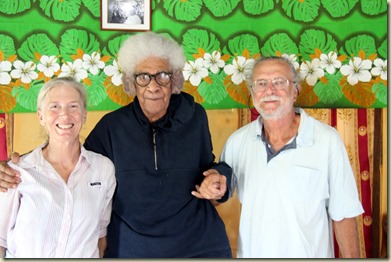
The 96 year old chief was good natured and happy to stand for a picture with us after the ceremony (some say he is 91, others 94). Fulanga is very organized as it comes to cruisers. They request a $50 donation (about $25 US) along with the traditional kava. Kava gifts are a little more important here as the island does not support its growth. As part of the organized cruiser welcome, after the sevusevu ceremony each cruiser boat is assigned a host family. You head back to their house for a snack and basic introductions. They are interested in your life and family and very willing to share information about their family and village life. Anything you want to do that concerns the village you pass through your host family.
FulangaIMG_7433
This is our host family’s, Niko and Lucy, house. The high roofed area at the left is cooking area, all done on a wood stove. The building to the right was Nikko’s grandfathers – interior pics to come.
FulangaIMG_7436
Traditional Fijian houses have no sitting furniture, just a small bed and a large, hand-woven mat to sit on. Here is Niko and Lucy posing with Chris after we all had tea and some sweet potato while sitting on the mat. The blue and white soccer ball was a small gift that we gave to the family to share with the village kids. Their children are older with the eldest working in a Musket Cove resort and the younger at high school in Suva. Fijians are extremely giving, always offering things they have made, cooked or harvested. And likewise are happy to accept pretty much anything we have and while feeling very comfortable to ask for gifts.
FulangaIMG_7514
When Niko found out that Chris was interested in shell collecting the next time we visited the village he gave her this hand carved wood Nautilus bowl.
FulangaIMG_7463Latter when we had Niko and Lucy along with their milk consuming nephew out to the boat we gave them some additional gifts. Lucy got some very fine crocheting needles for her fishing-net making projects. Niko got a couple of my old chisels for his carving work along with an old hand drill. Both gifts went over well. The young nephew, Johnny, was split between the milk and the small soccer ball we blew up for him.
FulangaIMG_7439 This is one of the few villages in the Lau Group that ‘still’ has the sailing outriggers, or waka (or vaka or a host of other spellings). I put still in quotes as this one still floats, but just barely. There was another decayed one on the beach. It’s a shame that this history and talent seems to be fading away here, unlike the vigorous revival we saw in parts of Polynesia further east.
FulangaIMG_7451
This is the 100+ year old interior roof of Niko’s grandfather’s place. It is hand bent and connected with twine. The roof started out life as palm frond covered and now has a corrugated steel covering. The roof looks as solid as the day it was made, even after having endured countless Pacific cyclones.
FulangaIMG_7452
This is the interior of the house where Lucy is working on a large woven pandanus (a local plant)mat. These are very durable mats that have an interesting pattern woven into them.
FulangaIMG_7443
The government in Suva subsidizes a fair amount of the village life including schools, health clinic and some infrastructure like this water container. The containers have recently been sent out to the village as cisterns to collect water off the roof tops. It’s getting near national election time, so reminding the outer villages of the benevolence of the current government makes for useful politics.
FulangaIMG_7449
The school teaches 47 students with instructors who are rotated through by the Ministry of Education on a five year schedule. The solar powered satellite dish in the background provides a limited phone service for the village and the possibility of an internet connection some time in the future.
The string barricade is a novel use of plastic bottles found on the beach and painted by the school kids.
FulangaIMG_7453
We stopped by to have a chat with the resident nurse at the clinic and to drop of some of our excess med supplies. The nurse has been at the village for about two months on a 3 year assignment. Any supplies she gets come on the monthly, at least that’s the schedule, ferry that comes in from Suva. Childbirth is no longer done on the outer islands. Instead, mothers-to-be head into Suva to stay with relatives until it is time to deliver in a Suva hospital.
Paul

Thursday, September 14, 2017

Yagasa Group

YasagaIMG_7392
We did a day-sail from the Bay of Islands to an anchorage on the west side of Lakemba. Spent the night and then sailed off in the early morning in a fairly strong NE wind toward the Yasaga Group (pronounced yan-gasa and sometimes spelt that way too). As we passed north of Namuka island we crossed the Bounty Boat Passage. This is where Capt. Bligh  passed through the eastern portion of Fiji on the longboat off the Bounty with his 18 loyal crew after being rudely ejected by Fletcher Christen and his followers in the famous Mutiny on the Bounty. While navigating through the uncharted islands in a feat of superb seamanship focused on saving the life of his loyal crew (and himself) he managed to take the time to accurately chart the islands as they passed through in 1789.
Yagasa is an uninhabited group of islands surrounded by a barrier reef. We tucked behind Navuilonga island to hide from the strong winds (18* 58.391S 178* 28.892W) in 45ft of water with some bommines around. It was a pleasant spot to hide out and it was only Georgia and the German boat, Qi, there. It felt very remote.
When the winds shifted back to SW and then SE we scooted around to the other side of the island and anchored in a nice small bay (18* 37.660S 178* 29.28W) in 15ft over shallow sand. Not great holding but well blocked from the wind. While the islands are uninhabited you see plenty of detritus in the fisherman camps. The fishermen come over from the neighboring islands and stay a few days to fish and sometimes to collect wood for their carving activities. The west facing bays had almost as much plastic waste on them as we’d seen in Panama. Not sure where it all came from as the winds are prevailing SE and there is a lot of water east of here till you hit anything that looks like civilization.
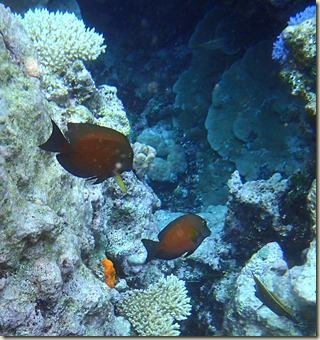
Yasaga_P9010023Since a front was passing over we didn’t have good weather. Even with the cloudy skies the clear water was really impressive. We dove a few of the bommies, once by dinghy and once we took out
and anchored close to one.
Yasaga_P9010025
Yasaga_P9010028
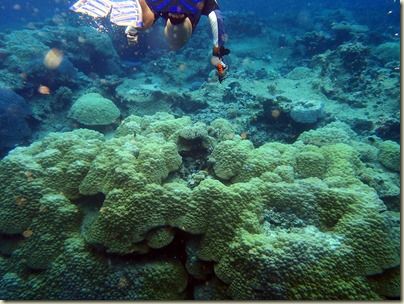
Just to give an you idea of the scale of the hard corals this is Chris with her GoPro.
Yasaga_P9010029
For all the dives we’ve done we still never get bored with the rainbow of colors on the reef
Yasaga_P9010034
Yasaga_P9010036
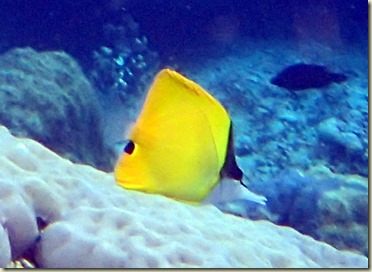
A Long-nose Butterfly fish brightening up our day
YasagaP9010022
There are giant clam shells laying all over the fishermen’s camps, so it was nice to see some still alive on the reefs.
Enough gratuitous underwater shots. After 3 nights we beat our way down to Fulanga – the next blog update.
Paul

Wednesday, September 13, 2017

Bay of Islands, Lau Group

BOILauIMG_7188
We waited in Oamea for the winds to turn NE before making the 50 mile sail to the Lau Group. The Lau is a group of islands on the eastern edge of Fiji that tends to be much more traditional and pretty much completely undeveloped. The sail to the Bay of Islands, Vanuabalvu (spelt many ways on the various charts) was the best sail we’ve had in Fiji so far. We spent a night in the Bay of Islands anchorage and then the next morning we loaded up cruisers from Qi (Chi), Family Circus and Moondancer onto Georgia and motored over to the anchorage off the village of Daliconi.
BOILauIMG_7170
The crowd on Georgia including two kids off Family Circus on our way to the village
BOILauIMG_7182
The point of the visit was so that all the boats could do their sevusevu. This is a Fijian custom where any visitor to a village or area visits the chief and presents a bundle of kava. Kava is a mild narcotic that is very popular in the South Pacific. It is a tea made from the dried stems of a local pepper plant. You can see the bundles wrapped in newspaper at the chief’s feet lying on the mat along with other gifts brought by cruisers for the village. Once the ceremony is complete you are given permission to visit the adjacent islands and bays, along with permission to dive and collect shells, etc. There is a fair amount of presentation made in Fijian by your representative along with strategic slow, bass sounding claps.
BOILauIMG_7202
After the sevusevu ceremony we walked around the small village and ended up at the friendly bakers shed.
BOILauIMG_7191
He bakes sweet rolls and bread for the villagers in this homemade, wood burning, oven. This appeared to be the only business in the village. There are some cows inland and long-boats for fishing. The island also has a copra plantation (coconut trees) that was hit very hard by Cyclone Winston.
BOILauIMG_7194
We hiked along the road toward the village school.
BOILauIMG_7197
School house door
BOILauIMG_7198
With some interesting posters, such as No Glue Sniffing.
BOILauIMG_7200
If they only had this sign in my elementary school in Davie Florida I bet my early school life would have been much better.
BOILauIMG_7199
The Lau Group are dry islands, ie; no alcohol. A few of them have some slow cell phone based Internet, while most others have nothing. The supply ferry visits some islands twice a month, others once a month. The main town stores have a few staples and that’s it.
BOILauIMG_7210
The area that we spent most of time in is called the Bay of Islands for the small rock islets that are behind Georgia here.
BOILauIMG_7230
BOILauIMG_7231
Here’s some better views
BOIP8250527
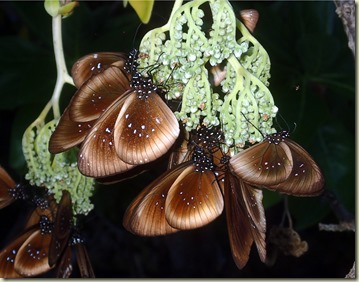
Moths taking a pollen break on the beach vegetation
BOIP8250525
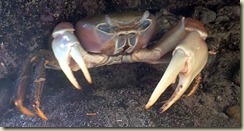
This gal wasn’t happy that we were intruding on her beach, even though we had done the sevusevu.
BOI_P8200479
We saw a few interesting soft-corals among the coral bommies
BOI_P8200481
Sometimes these look like delicate lace and others times its more varicose veins like.
BOI_P8230488
We didn’t see many larger fish, but lots of small tropical reef fish like these damsel fish who quickly hide in the coral (behind them) if startled.
BOI_P8230498
The clear water makes for some impressive coral scapes.
BOIIMG_7331
We went into Little Bay on the north end of the island for a night and some SUPing. The entrance is pretty narrow but you can SUP in almost a mile.
BOI_LittleHHarbourP8250505
Paddle boarding in Little Bay.
BOIIMG_7270
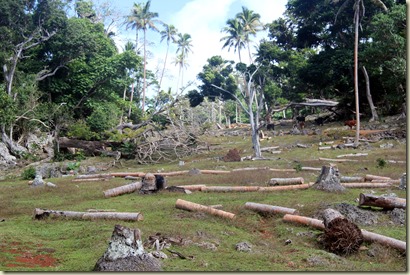
We also spent a few nights in Bavatu harbour on the north coast. This is the main bay for the copra (dried coconut) plantation. It took a beating from Cyclone Winston as you can see here.
BOIIMG_7274
It was nice to get off the boat and get in a few hours of hiking. Those specs under the tress are sheep. The plantation had cattle, sheep, pigs and chickens.
BOIIMG_7294
It clearly had more buildings prior to Winston.
BOIIMG_7300
One of the plantation owners houses high above the bay on a cliff face.
BOIIMG_7305
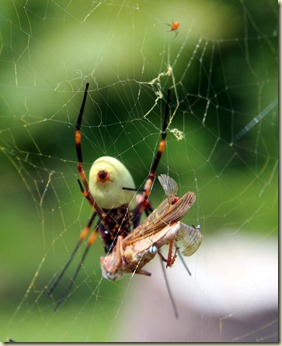
This large spider, Charlotte I believe, was devouring this moth along the trail. There is a little red spider just above her wanting to get in on the action and hoping not to become the next meal.
BOIIMG_7306
This shed foundation with the shed contents perfectly in place was just lacking the shed building that must have been blown away by Winston.
BOIIMG_7284
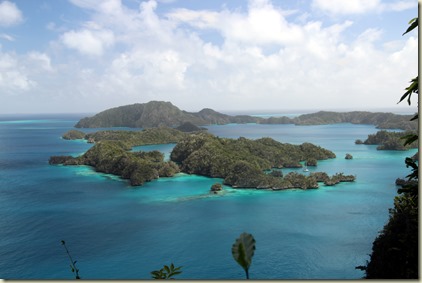
Nice view of the Bay of Islands from high up on the cliff.
BOIIMG_7371
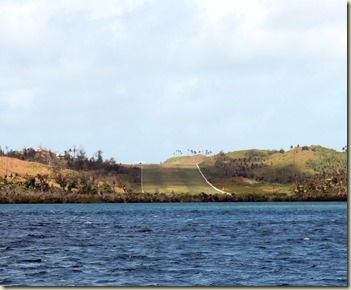
We motored over to the bay just south of the Daliconi village, aka Airport Bay. This is the grass airstrip that has a pretty steep grade up the hillside. On our way over to the bay we drove out the Adavaci Pass between the outer reefs. We did this so we would have a track to follow in the earlier morning when it would not be enough light to see the bommies.
BOIIMG_7373
We really enjoyed our time in Banuvalevu but it was time to head further south in the Lau Group. We were inspired to get moving because the World Oyster Rally showed up with 30 boats. If you click on the image above you can see the oysters at anchor in the wee early morning light with there mast head anchor lights on. We took the picture on our way out to make the passage to Lakemba. Oyster is a British boat manufacturer that every few years organizes a rally where they circumnavigate the world in 27 months. We last ran into them in St Pierre, Martinique 3 or 4 years ago. It’s hard to visit remote and desolate places with your closest 90 friends.
BOIIMG_7362
Shelling in Fiji has not been as a good as Tonga, but when you put them all in one place the haul looks pretty impressive.
Paul