No Interweb for awhile now, so this is an SSB radio post- sans pics.
We held up an extra day in Plays del Coco so I could pickup some aluminum brackets I had made there. It was raining, so we hung out at a local restaurant, Woody's, with ok food, cool parrots and great wi-fi, till the brackets were supposed to be ready. I walked across the street and found a car masquerading as a taxi. 'How much to take me to the Metal Shop?' He says 1,000 colona, about two bucks. I say sure and jump in out of the rain. He starts to drive off and turn in the wrong direction. He had no clue where I wanted to go. We got that straightened out. He then starts to till me how dangerous it is to drive in the rain here. We showed up at the metal shop in one piece where they quickly said to come back in an hour. Back to town. After an hour I find the same taxi driver. This time he drives me straight to Metal shop. I head in, grab the parts, pay for them, and BS some with the owner about how hard it is to do business in CR. I walk out to grab the taxi and he has taken off. I never paid him for the second trip. The workers at the shop looked dumbfounded when I just said 'Costa Rica???' It was a long hike back into Coco.
One more crotch soaking and we were through the surf and back onto the boat. Next morning we took off for Playa Potrero, aka Playa Flamingo, aka Marina Flamingo. This place used to have a large marina and fuel dock. Today it is just an abandoned break water that you aren't allowed to land at. We headed here to see Kelvin on Le Bateau. He was busily trying to get his boat back together enough, after it's lightening strike in Coco, to move it south to Punta Arenas for a haul out. 'Busily' means it takes forever to get a simple job done. We went in on the bus with Kelvin so he could buy a fan belt to finish mounting his replacement alternator, the other having been fried. Two bus rides and six hours later we had acquired two fan belts.
The lightening strike did a couple odd things to Le Bateau. It blew the floor boards off onto the settees and sprayed water out of the bilge all over everything- presumably boiling at the time, thankfully they weren't on board at the time. He has a polished stainless steel Bruce style anchor; on one fluke and one side of the shank you can see the rainbow colors of steel having been heated way hot. The lightening must have exited down the chain.
Our plan was to buddy boat/escort Le Bateau to Punta Arenas, just in case anymore troubles showed up on the passage. Kelvin couldn't get the OK to move the boat from his insurance company. They wanted an inspection prior. Also, Ginny was not getting back in town for 10-days. We entertained Kelvin for two days and then abandoned him. Next we took off for an overnight sail to Bahia Balleena. Sail is a bit too strong. We motored all but 2 hours of it. Finally started seeing some commercial, panga, fishing again. There's been nothing since El Salvador. More little black flags with long lines attached just waiting to catch your keel.
Not much to be said for Bahia Ballena. It has a concrete pier that takes gymnastics and multiple tie off lines to off pier points to land at. There's a large bar/restaurant known as Bahia Ballena Yacht Club next to the pier. It wasn't open over the 2 days we were there. It did, however, nicely beam wi-fi into the bay. The town is a couple of mile hike in from there with a decent store. Our refrigeration is down till we can get some replacement washers in Golfito, so we picked up a couple of bags of ice. They were a lot lighter by the time we'd hiked them back to the boat.
A big south swell picked up, so our second night was rolly in the anchorage. We left early in the morning to cross the Golfo Nicoya on our way to Quepos. Just outside the bay at around 6am we managed to pickup a long line on our keel. This one put up a fight. We finally cut it loose, carefully re-tied it and took off, only to get retangled in the same long line. We cut that one loose, re-tied, and headed way, way clear of the black flag. Then as we got back on our course a couple fishermen in a panga came up beside us making the international hand waving signals for 'stop, stop'. I stuck the engine in neutral. He came close and I figured he was going to negotiate the damage to his long line. Instead he reached down and grabbed the long line that had gotten fouled, for the third time, on our keel. He opened his ice chest, pulled out a 2 foot machete and sliced the line. No attempt to re-tie it to save it. Just cut and throw it back in. Then it was Adios and we were off. The crossing of the Nicoya gulf was a little like sailing in British Columbia. Non-stop floating logs. After about 3 hours of dodging logs the waters cleaned up.
We made Quepos around 5pm,just before the afternoon rain storm hit. The swell had gotten larger and more cleanly formed over the day. It was clear that the anchorage in Quepos would suck. There's a new marina in Quepos, Marina Pez Vela. It charges something like $80-90 a night for transients-- ridiculous. Of course it is 3/4 empty. We took one look at the anchorage, as it sits right in front of the surf break, and headed straight back out. There's another small anchorage off Punta Quepos that was supposed to be more protected- because it's surrounded by reefs and rocks. As it got dark we dropped the hook in 35 feet of water with the swell cut down to a few feet. This made for another sleepless, rolly night.
Today we got fuel in Quepos and are heading south to Dominicalito anchorage. It is supposed to be a little less rolly than the next. But, until this swell lies down there aren't any decent anchorages for the next 100 miles. Makes it hard to enjoy the jungle and parks of central CR. We should be in Golfito in 4 or 5 days -laying in a flat calm anchorage.
-----
OK, we made it to Bahia Dominicalito. You anchor behind a rock reef that extends from the point. After some trials and tribulations we got bow and stern anchors down. This place is not going to go down as one of our good night sleeps. Even tucked behind the reef, there's still a 4ft plus swell shaking us around. Lucky we got a cold 6 pack of Imperial Silver, the local cerveza, when we got fuel and ice at the marina. Too bad we don't have any of our cruising buddies from Mexico or El Salvador to share them with. I think we'll be up at dawn and off to Bahia Drake in the morning, in search of a better anchorage.
Paul
----------
radio email processed by SailMail
for information see: http://www.sailmail.com
Wednesday, June 22, 2011


Friday, June 17, 2011
Zipping along through life
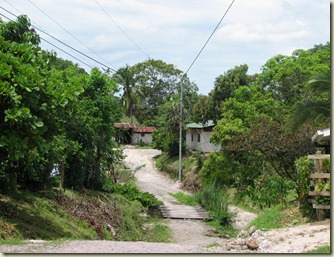
Dennis & Virginia on Libertad have their brother (in-law), Greg, down for a 10 day visit. So they rented a car yesterday ($55 a day from National, delivered to Marina Papagayo) to head up to the nearby mountains in Parque Nacional Rincon de la Vieja (the Old Lady’s Corner) to do a zip line canopy tour. Chris & I tagged along. Dennis did the driving and Greg the navigating. There are a group of lodges all located in the same mountain area that do zip lining. The thing they all have in common is the driving directions. They all say go to Liberia (the ‘big’ city closest to us here in Bahia Culebra/Playas Coco), go to the traffic light and turn left at the major landmark, the Burger King. After that you travel out into ranch and farm country on a decent road. One thing that stands out here in Costa Rica is that the roadsides are clean – practically no trash. What a contrast to El Salvador, where it all goes out the bus window. Mexico is somewhere between Costa Rica and El Salvador, closer to El Salvador, for road trash.
We paid our $40 for zip line tickets – backing off from the $80 for the big package do-everything ticket. They took us to a building that looked like a paddock and we suited up.


 OK, I finally had to give in and start showing on the blog pictures of our food. Lunch for 2,500 colona (5 bucks US)
In search of the Internet
We really wanted to setup a 3G USB Modem like the Banda Ancha we’d used in Mexico. Cell towers are everywhere here, so it seemed like a request that was within human reason to get accomplished. Two trips to the electronics and cell stores in Playas Del Coco struck out. They both had the USB modems (dongles) for sale for reasonable prices. However, neither one could sell you the SIM card that started the service. For that you had to travel into the big city, Liberia, and go to the cell company, ICE (ee-say), main office. The office is like any big telephone company office– meet the receptionist,explain your issues, take a number. When your number is called, go to the correct desk. The receptionist set us up so our number would match the desk where the assistant spoke pretty good English. She first spent time looking up the part number of the Bana Ancha modem we already owned to see if it was supported on their system. No, but it might work. Then we talked about the various plans (sounds like $27 a month for unlimited data download/access). Then she let out that if you aren’t a resident of Costa Rica you can’t get a data plan. The issue is that the data plans are not pre-pay. They are month to month contract that you can cancel at anytime without a fee. The problem is that the tourists don’t cancel the plans when they leave and the phone company can’t collect from them. Bottom line – no data card for non-residents. Too bad because we had a bunch of pictures of each meal we ate to show our blog reader.

No trash!
The road then goes to dirt and you start climbing into the mountains more. Looking at the brochures, you seem to have two choices in getting to the start of the zip line, either horseback or tractor pulling a hay wagon type cart. We debated this, with the consensus leaning toward no horses.We paid our $40 for zip line tickets – backing off from the $80 for the big package do-everything ticket. They took us to a building that looked like a paddock and we suited up.

Chris with here double head protection on.
After we suited up we followed the guide up the trail and started the hike to the top of the zip lines. This answered the question of how we would get to the top. Apparently our ticket was for the budget run. At Buena Vista there are 11 zip lines that run along the top of the canopy from tree platform to platform. The first one is the short, mellow training one. They show you how not to get your fingers removed by the slide and how to brake (by hand- pull down on the wire). I was pretty convinced that the diaper harness I was wearing was going to emasculate me.

Chris Zoom!! Coming in for the landing.

Paul Zoom!! Take off.

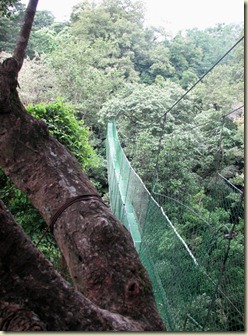
Suspension bridge above the canopy along the way- that’s the canopy bridge tour.
After we all got out our bucket-lists and crossed off Jungle canopy zip line, Costa Rica, we headed back down the mountain back to Liberia (and the Burger King landmark) to do some provisioning. We decided to pass on the Home of the Whopper and went to a Tipica local place.
 OK, I finally had to give in and start showing on the blog pictures of our food. Lunch for 2,500 colona (5 bucks US)
We were going to leave Playa Panama to head to Bahia Protrero today. This is where our friends Kelvin and Ginny on Le Bateau is holed up trying to get his boat back together after a lightening strike. While we had the car we stopped by a metal working shop in Coco. They are going to make up a set of aluminum brackets so I can mount a tiller pilot to drive the wind vane. It should be ready tomorrow, so we’ll hang out today and then on to Protrero in the morning to catch up with Le Bateau.
In search of the Internet
We really wanted to setup a 3G USB Modem like the Banda Ancha we’d used in Mexico. Cell towers are everywhere here, so it seemed like a request that was within human reason to get accomplished. Two trips to the electronics and cell stores in Playas Del Coco struck out. They both had the USB modems (dongles) for sale for reasonable prices. However, neither one could sell you the SIM card that started the service. For that you had to travel into the big city, Liberia, and go to the cell company, ICE (ee-say), main office. The office is like any big telephone company office– meet the receptionist,explain your issues, take a number. When your number is called, go to the correct desk. The receptionist set us up so our number would match the desk where the assistant spoke pretty good English. She first spent time looking up the part number of the Bana Ancha modem we already owned to see if it was supported on their system. No, but it might work. Then we talked about the various plans (sounds like $27 a month for unlimited data download/access). Then she let out that if you aren’t a resident of Costa Rica you can’t get a data plan. The issue is that the data plans are not pre-pay. They are month to month contract that you can cancel at anytime without a fee. The problem is that the tourists don’t cancel the plans when they leave and the phone company can’t collect from them. Bottom line – no data card for non-residents. Too bad because we had a bunch of pictures of each meal we ate to show our blog reader.
Paul
Sunday, June 12, 2011
The Costa Rican Treasure Hunt
When you arrive at any country by sailboat from a foreign port you have to check-into the country, i.e do the customs and immigration two-step. In Costa Rica the first stop is the Port Captain. As our friend Pam on Precious Metal describes it, you go into the Port Captains office, he looks over your exit Zarpe from the previous country and then hands you the list of all the things you’ll need to find on your multi-day treasure hunt. When you’ve gotten everything on the list you return to the port captain and he blesses you with your entry Zarpe, or it’s equivalent.
We anchored outside the mooring balls in Playas del Coco, a small town which is the northern most port of entry in CR. This is a nice tropical bay, but with two major draw backs. The surf rolls in through the anchorage which makes it really rocky and uncomfortable on the boat. Then, the resulting shore break makes each and every dinghy landing and re-launch an exciting, if not life-threatening, experience. At the very least you just have to plan on getting your crotch wet in the 86-degree water each time you go ashore. A new fashion statement for in town wear.
There’s the remains of the old pier that is on the beach near the center bay reef. This makes for the best dinghy landing spot. Here, if you dump the dink you can be sure someone, locals and tourists, will be there to see the spectacle. We dragged our dink up the beach on the deflated dinghy wheels and locked it to a post near the pier. We haven’t been able to find a bicycle pump that has a nozzle that is small enough to fit on the tubes on the Danard dinghy wheels. We shake off like a dog that just had a bath and head up the beach and onto the main road – where the Port Captain’s office is conveniently located. He looked through our papers, told us which ones we didn’t have enough copies of, gave us carbon copy forms to fill out – all with a friendly attitude. Checking into Costa Rica is supposed to be free, however due to a few minor expenses and fees, it actually ends up costing about $100USD.
First stop was the bank to pay the agriculture inspection fee of approx $50. You pay it in colonas—which are 500c to 1USD—so it feels overwhelmingly expensive: 28,700 colonas. The Port Captain called Immigracion for us to make sure she’d be there – she said come by at 3pm. The bank is next door to the immigration office, 300 yards up the main road from Port Captain’s. Both the Port Captain and Immigration made us fill out forms that list the last 5 ports and dates of exit from them. The dates we kind of made up, as no one really cares and we really couldn’t remember. The lady at Immigration gave us a 90-day visa – that’s the max from the local office.
It was late and we had to wait for our 8:30am appointment with the Agriculture inspector before we could hunt for anymore treasures. So it was back in the dingy, back through the surf and a wet crouch again. We spent a rolly uncomfortable night – this means that it took Chris over 5 minutes to fall a sleep, I , on the other hand, truly slept like crap.

The next part of the hunt was to go to the Customs office (Aduana) for our temporary import permit. Somehow we were making too good a progress on the hunt, so they threw in one extra bonus stop back at Immigration to drop off another copy of the crew list. Customs would be easy except for the fact that it is located next to the airport in Liberia which is 45 minutes away. You can take a bus from Coco for about a dollar. They leave once an hour, more or less. The problem is that you can’t seem to take a bus back from Aduana, which means you need to find a taxi to get back from the airport, at $50. Fortunately Walter and his teal green pickup truck found us. He hangs out across the street from the Port Captains office. He’ll run you out to customs and back for $50. Along the way he’ll tell you what a beautiful country Costa Rica is, in very clear slow Spanish. Costa Rica has a reputation for petty theft, but Walter assured us that that is all carried out by the Nicaraguans who have invaded his country.
Costa Rica has no military. As they say, it is a peaceful place. When we drove by the airport on the way to customs there were two military planes there, a P-8 AWACS and a C-130 Coast Guard plane, both US military drug interdiction planes – your tax dollars at work.
Customs gave us a 90-day Temporary Import Permit, to bring the boat and all of our belongings onboard into the country, to match our 90-day visa. And that completed the treasure hunt and we were declared a winner.
As Treasure Hunt winner and a duly checked-in boat we were finally given the right to go over to Marina Papagayo and buy diesel from them-- at $5.16 a gallon. Ouch.
Tonight we are anchored at Playa Panama-– a smooth and protected anchorage within the beautiful Bahia Culebra with a nice, high-end hotel ashore that lets us go to the open air bar to drink beer and use their WiFi… with much less exciting dinghy landings.

Paul & Chris
We anchored outside the mooring balls in Playas del Coco, a small town which is the northern most port of entry in CR. This is a nice tropical bay, but with two major draw backs. The surf rolls in through the anchorage which makes it really rocky and uncomfortable on the boat. Then, the resulting shore break makes each and every dinghy landing and re-launch an exciting, if not life-threatening, experience. At the very least you just have to plan on getting your crotch wet in the 86-degree water each time you go ashore. A new fashion statement for in town wear.
There’s the remains of the old pier that is on the beach near the center bay reef. This makes for the best dinghy landing spot. Here, if you dump the dink you can be sure someone, locals and tourists, will be there to see the spectacle. We dragged our dink up the beach on the deflated dinghy wheels and locked it to a post near the pier. We haven’t been able to find a bicycle pump that has a nozzle that is small enough to fit on the tubes on the Danard dinghy wheels. We shake off like a dog that just had a bath and head up the beach and onto the main road – where the Port Captain’s office is conveniently located. He looked through our papers, told us which ones we didn’t have enough copies of, gave us carbon copy forms to fill out – all with a friendly attitude. Checking into Costa Rica is supposed to be free, however due to a few minor expenses and fees, it actually ends up costing about $100USD.
First stop was the bank to pay the agriculture inspection fee of approx $50. You pay it in colonas—which are 500c to 1USD—so it feels overwhelmingly expensive: 28,700 colonas. The Port Captain called Immigracion for us to make sure she’d be there – she said come by at 3pm. The bank is next door to the immigration office, 300 yards up the main road from Port Captain’s. Both the Port Captain and Immigration made us fill out forms that list the last 5 ports and dates of exit from them. The dates we kind of made up, as no one really cares and we really couldn’t remember. The lady at Immigration gave us a 90-day visa – that’s the max from the local office.
It was late and we had to wait for our 8:30am appointment with the Agriculture inspector before we could hunt for anymore treasures. So it was back in the dingy, back through the surf and a wet crouch again. We spent a rolly uncomfortable night – this means that it took Chris over 5 minutes to fall a sleep, I , on the other hand, truly slept like crap.

Eduardo inspecting the fruits and veggies of Jeorgia
Next morning we took the dinghy in through the surf. It was a little smaller this time – crotch still got wet. We hung outside the Port Captains office waiting for the Agricultural Inspector. The weird thing about this inspection is that there doesn’t seem to be any list of prohibited foods. He pulled up on a motorcycle with long pants and street shoes. I just couldn’t see how we were going to get him out through the surf in our dinghy without getting him at least partially soaked. Eduardo, the inspector, headed into the Port Captains office. He came out with his bathing suit on and his official name tag on around his neck, nothing else. This guy had obviously been abused by cruisers before. He was a good guy, spoke no English. The net of his visit was that he wanted us to make sure we ate all our fruits and vegies before we left Costa Rica – a valuable tip for $50.The next part of the hunt was to go to the Customs office (Aduana) for our temporary import permit. Somehow we were making too good a progress on the hunt, so they threw in one extra bonus stop back at Immigration to drop off another copy of the crew list. Customs would be easy except for the fact that it is located next to the airport in Liberia which is 45 minutes away. You can take a bus from Coco for about a dollar. They leave once an hour, more or less. The problem is that you can’t seem to take a bus back from Aduana, which means you need to find a taxi to get back from the airport, at $50. Fortunately Walter and his teal green pickup truck found us. He hangs out across the street from the Port Captains office. He’ll run you out to customs and back for $50. Along the way he’ll tell you what a beautiful country Costa Rica is, in very clear slow Spanish. Costa Rica has a reputation for petty theft, but Walter assured us that that is all carried out by the Nicaraguans who have invaded his country.
Costa Rica has no military. As they say, it is a peaceful place. When we drove by the airport on the way to customs there were two military planes there, a P-8 AWACS and a C-130 Coast Guard plane, both US military drug interdiction planes – your tax dollars at work.
Customs gave us a 90-day Temporary Import Permit, to bring the boat and all of our belongings onboard into the country, to match our 90-day visa. And that completed the treasure hunt and we were declared a winner.
As Treasure Hunt winner and a duly checked-in boat we were finally given the right to go over to Marina Papagayo and buy diesel from them-- at $5.16 a gallon. Ouch.
Tonight we are anchored at Playa Panama-– a smooth and protected anchorage within the beautiful Bahia Culebra with a nice, high-end hotel ashore that lets us go to the open air bar to drink beer and use their WiFi… with much less exciting dinghy landings.

Jeorgia resting in Playa Panama, Costa Rica
The Treasure HuntersPaul & Chris
Subscribe to:
Posts (Atom)

 Posts
Posts


